


Discover Different Types of UAV/Drone Motors And How They Work
Motors are among the most important components of an unmanned aerial vehicle (UAV). While the airframe determines the aircraft’s shape and payload capacity, the motor determines how the UAV takes off, accelerates, maintains altitude, and completes its mission. Join Motronix as we explore the most common types of UAV motors and discover their key features to better understand the motor technologies powering today’s advanced unmanned aerial vehicles.
What Are the Different Types of UAV/Drone Motors?
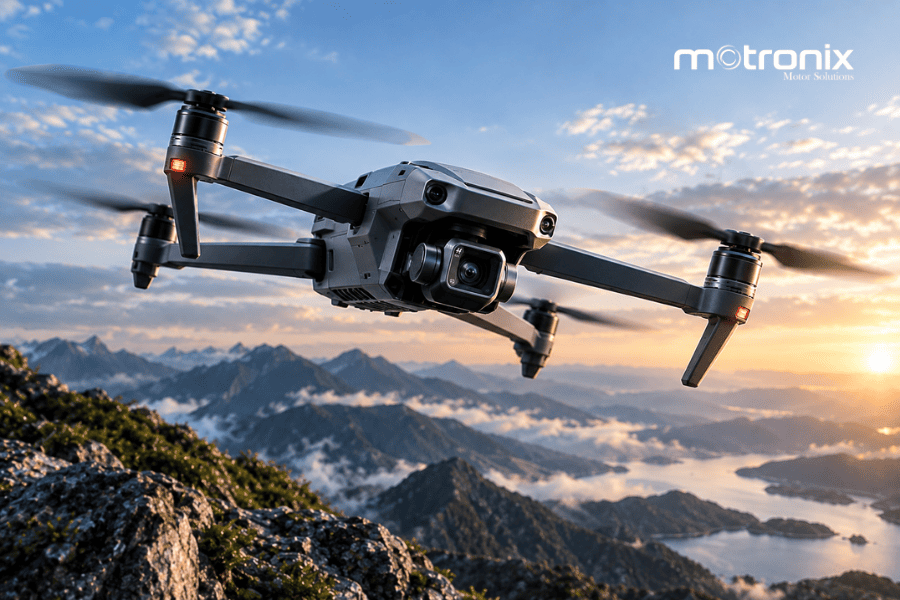
What Are the Different Types of UAV/Drone Motors?
Brushless Electric Motors
Brushless motors (Brushless Motors/BLDC Motors) are widely used in multirotor drones, FPV drones, aerial photography, mapping, and industrial UAVs. These motors generate force through a rotating magnetic field produced by electric current. The magnetic rotor transfers motion to the propeller, while the electronic speed controller (ESC) enables fast and precise speed adjustment.
With an efficiency of approximately 85–90%, brushless motors offer several advantages: low weight, quiet operation, low vibration, durability, and minimal maintenance. However, flight time is typically limited to around 20–60 minutes, depending on battery capacity. The motor and ESC may also overheat when operating at high power.
Gasoline Engines for UAVs
Gasoline engines generate thrust by combusting a mixture of gasoline and air inside a cylinder. The piston's movement is converted through the crankshaft to drive the propeller.
Because gasoline has a higher energy density than lithium batteries, gasoline engines enable UAVs to fly longer, carry heavier payloads, and refuel quickly. These engines are suitable for reconnaissance, large-area mapping, agricultural spraying, cargo transport, and scientific research.
Their main limitations include high noise and vibration, requiring a robust airframe and an appropriate vibration-damping system. Engines also need regular maintenance, including checks of the spark plugs, lubricating oil, filters, and fuel system. Performance can vary with fuel quality, temperature, altitude, and air density. Emissions must also be considered when operating in environmentally sensitive areas.
Jet Engines for UAVs
Jet engines generate thrust by drawing in and compressing air, mixing it with fuel for combustion, and then expelling hot gases through a nozzle. These systems offer the highest power density and high-speed capabilities, making them suitable for jet-powered model aircraft, target drones, experimental aircraft, and specialized research platforms.
Turbojets have a compact structure, rapid response, and a high thrust-to-weight ratio of approximately 8:1–12:1. However, they consume large amounts of fuel, generate substantial heat, operate less efficiently at subsonic speeds, and may produce noise levels exceeding 130 dB. Due to their demanding requirements for materials, lubrication, and control systems, turbojets are unsuitable for conventional consumer drones.
Turbofans incorporate a large fan at the front of the engine core to reduce noise and improve fuel efficiency. Compared with turbojets, turbofans provide more stable thrust and may reduce fuel consumption by approximately 20–30%. They are suitable for larger UAVs designed for long-range cruising, although their structures are more complex.
Hybrid Engines for UAVs
Hybrid propulsion systems combine an internal combustion engine, an electric generator, a battery, and an electric motor. The fuel-powered engine supplies energy to the generator, while the electric motor produces thrust. The battery provides additional power during takeoff, landing, or acceleration, while the fuel-powered engine supplies a more consistent energy source during cruise.
By combining fuel and electricity, hybrid systems can potentially extend flight time by approximately 3–5 times, with medium-sized UAVs achieving around 4–10 hours, depending on design and payload. These systems also allow rapid refueling, flexible operation, and improved redundancy.
The main limitations are structural complexity, increased weight, and integration costs that may be 20–30% higher than those of fully electric systems. The engine, generator, and battery produce considerable heat, requiring dedicated cooling. The motor, ESC, generator, and flight controller must also be precisely synchronized.
Hybrid propulsion is suitable for fixed-wing UAVs designed for long-range flights, VTOL UAVs, cargo drones, pipeline and power-line inspection, and energy research platforms.
How Do Different UAV and Drone Motors Affect Flight Performance?
The motor type directly determines a UAV's thrust, payload capacity, flight time, speed, and stability. Brushless electric motors offer rapid response and precise thrust control, but their continuous output is limited by battery capacity and heat dissipation. Gasoline and hybrid engines provide high torque and are suitable for UAVs carrying heavier payloads. Jet engines deliver the highest thrust-to-weight ratios, while hydrogen fuel cells provide a steady electrical output but respond more slowly to sudden power demands.
Electric multirotor drones typically fly for around 20–60 minutes, while fixed-wing UAVs may achieve approximately 90 minutes. Gasoline-powered engines can generally sustain operation for 3–10 hours, while hybrid systems may achieve 4–10 hours or longer. Some hydrogen fuel-cell platforms have also demonstrated continuous flight lasting several hours.
In terms of speed, electric UAV motors typically support speeds of around 100–160 km/h, potentially reaching 200 km/h when optimized for propeller design, voltage, and aerodynamics. Gasoline and hybrid engines are suitable for speed ranges of approximately 100–250 km/h. Jet-powered UAVs can reach 500–800 km/h or higher, depending on their design.
Noise and vibration also depend significantly on the propulsion system. Brushless electric motors and hydrogen fuel cells operate relatively quietly, making them suitable for aerial photography, mapping, and research in urban areas. Gasoline and hybrid engines generate more vibration due to combustion and mechanical movement. Jet engines produce high noise levels and heat and require stringent safety measures, making them primarily suitable for specialized missions.
Future Trends in UAV and Drone Motor Technology
Future UAV motor technology will focus on increasing energy density, reducing weight, improving safety, and optimizing control. Solid-state batteries are expected to increase energy density by approximately 30–50% compared with some current battery technologies, while lithium-sulfur batteries have a theoretical energy density of approximately 400–600 Wh/kg. These developments could enable electric UAVs to achieve flight times exceeding two hours. Graphene batteries and sodium-ion batteries also have potential in low- and mid-priced segments due to their cost advantages and durability.
Hydrogen fuel cells and hybrid propulsion systems are expected to see greater adoption in medium- and large-sized UAVs. High-pressure storage tanks, cryogenic hydrogen storage, and dual-source energy management technologies continue to be developed, enabling systems to automatically allocate energy between fuel, batteries, and hydrogen according to different flight stages.
In addition, miniature turbines and electrically assisted jet engines will be explored for UAVs requiring high speeds. Electric UAV motors could support takeoff, after which jet engines would handle the cruise phase. Artificial intelligence will also play an important role by monitoring voltage, current, temperature, and fuel consumption in real time. This will allow systems to adjust power automatically, issue maintenance alerts, and optimize flight time, helping improve UAV safety, reliability, and performance.
Motronix – A Trusted Supplier of High-Quality UAV Motors
At Motronix, we understand that the motor is a critical factor determining the thrust, performance, and stability of unmanned aerial vehicles (UAVs). As UAV applications continue to expand across surveying, agriculture, industrial inspection, and various specialized fields, Motronix aims to provide UAV motor solutions that meet requirements for performance, durability, and operational stability.
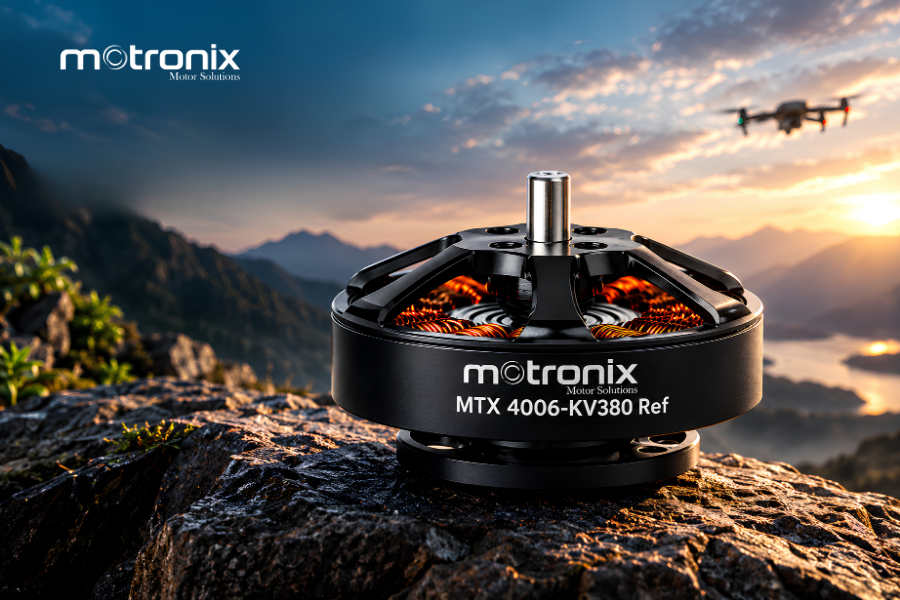
Motronix – A Trusted Supplier of High-Quality UAV Motors
With a focus on product quality and practical suitability, Motronix aims to help customers identify motor solutions that match the configuration and intended application of each UAV system, thereby contributing to improved operational efficiency.
Motronix – Supporting the advancement of UAV technology with high-quality, reliable motor solutions.
MOTRONIX VIET NAM CO., LTD
📍 Address: Lot TD253, Lai Xa Industrial Cluster Service Area, Hoai Duc Commune, Hanoi City, Vietnam
📞 Phone: +84- 979 731 229
☎️ Tel: 024 665 68006
📧 Email: infor@motronix.vn
