


The “Muscles and Joints” of Humanoid Robots: Core Technology for Flexible Motion
As humanoid robots continue to move closer to achieving natural, human-like motion, the technology behind each robotic joint is becoming more important than ever.
From walking and maintaining balance to rotating the body, lifting objects, and performing precise tasks, every movement requires a highly accurate motion system with fast and reliable feedback.
Among these technologies, the Harmonic Joint Module can be considered the “muscles and joints” of a humanoid robot, playing a critical role in delivering powerful, precise, and flexible movement.
What Is a Harmonic Joint Module?
A Harmonic Joint Module is an integrated motion unit that combines multiple critical components within a compact structure, typically including:
-
Servo motor
-
Harmonic reducer
-
Encoder
-
Brake
-
Sensors
-
Control and feedback components
Instead of designing and assembling each component separately, these elements are integrated into a single joint module. This approach helps simplify mechanical design, assembly, and overall robot system integration.
In simple terms:
-
Motor → Provides power
-
Harmonic reducer → Increases torque while reducing speed
-
Encoder → Provides position and speed feedback
-
Controller → Coordinates motion
The combination of these components enables the robot to control each joint in real time with high precision.
Why Are Harmonic Joint Modules Important for Humanoid Robots?
A humanoid robot needs to do more than simply “move.” It must move stably, accurately, smoothly, and flexibly, while adapting to changing real-world environments.
During operation, a humanoid robot may need to perform a wide range of complex movements, including:
-
Walking and maintaining balance
-
Standing up and sitting down
-
Rotating the hips and torso
-
Moving the arms
-
Grasping and manipulating objects
-
Adjusting posture on uneven surfaces
-
Coordinating multiple joints simultaneously
To achieve these capabilities, the motion system needs high torque, high precision, fast response, compact dimensions, and stable operation.
This is why Harmonic Joint Modules are becoming an increasingly important component in the development of humanoid robots.
High Integration – Simplifying Robot Development
In traditional designs, engineers need to select, assemble, align, and test numerous mechanical and electronic components individually.
This can increase development time and make system integration more complicated.
With an integrated Harmonic Joint Module, multiple critical components are combined into a single motion unit.
This can provide several advantages:
-
Reduced mechanical design complexity
-
Shorter development and assembly time
-
Fewer individual components
-
More efficient use of internal space
-
Easier maintenance and replacement
-
Better synchronization between joints
For humanoid robots with numerous moving joints, optimizing each individual module can have a significant impact on the overall robot design.
Compact Design – A Key Requirement for Humanoid Robots
One of the major challenges in humanoid robot development is achieving high torque within a compact and lightweight design.
A robotic joint must be powerful enough to support and move the robot's body, while remaining compact enough to fit inside the arms, legs, hips, shoulders, and other space-constrained areas.
Two important factors are the central hollow bore and the overall height of the joint module.
Large Central Hollow Bore
A large central hollow bore provides additional space for routing:
-
Power cables
-
Signal cables
-
Sensor wiring
-
Other internal components
This design allows for cleaner cable routing while helping reduce cable twisting as the joint continuously rotates.
However, maintaining high torque, rigidity, and reliability while incorporating a large hollow bore presents significant engineering challenges.
Low-Profile Joint Design
The overall height of the joint module also directly affects the robot's mechanical structure.
An oversized module can make the joint bulky, affecting the robot's proportions and range of motion.
Therefore, modern joint actuator development is increasingly focused on achieving:
Compact Size + High Torque + High Precision + High Integration
This combination helps humanoid robots achieve proportions closer to human anatomy while enabling smoother and more natural movement.
Harmonic Joint Modules Are Not Limited to Humanoid Robots
The potential of this technology extends far beyond humanoid robots.
Thanks to their compact design, high precision, and high level of integration, joint modules can be applied to a wide range of robotic and motion-control systems, including:
-
Industrial robots
-
Collaborative robots
-
Service robots
-
Bio-inspired robots
-
Medical robots
-
Robotic exoskeletons
-
Precision automation equipment
-
Specialized robotic mechanisms
As robots become lighter, more compact, and more intelligent, integrated motion solutions will continue to play an important role in optimizing robotic systems.
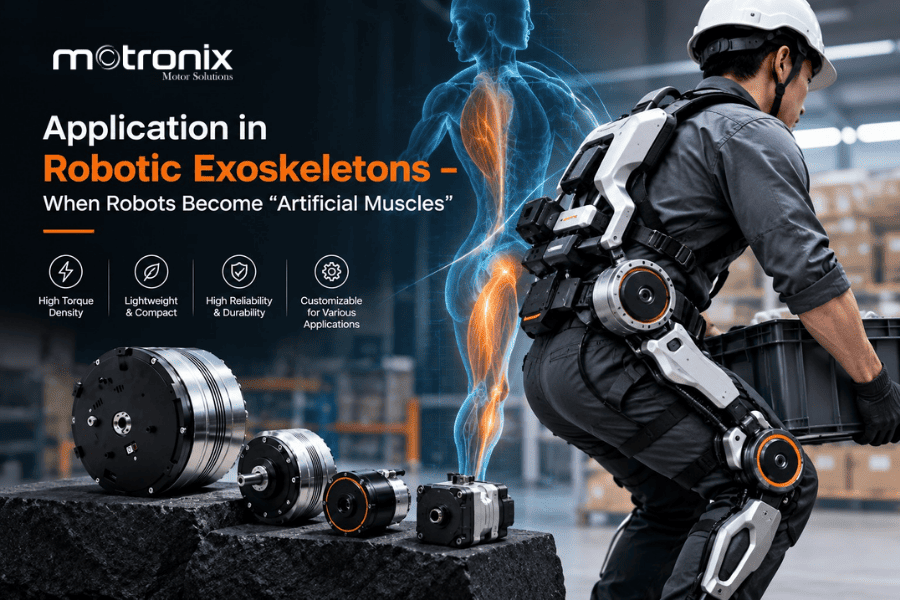
Application in Robotic Exoskeletons – When Robots Become “Artificial Muscles”
Application in Robotic Exoskeletons – When Robots Become “Artificial Muscles”
One notable application of joint module technology is the robotic exoskeleton.
Exoskeleton systems can combine sensors, AI, controllers, and joint actuators to detect and respond to the user's intended movements.
When the user intends to take a step, sensor data is processed by the control system to determine the desired movement and the required level of assistance. The joint actuator then generates the appropriate torque to support the movement.
The system can be simplified as:
AI + Sensors + Controller + Joint Module = Assisted Motion
In this application, the joint module is more than a mechanical component. It can function like an “artificial muscle,” generating controlled force to support users and enable more natural movement.
Key Factors to Consider When Selecting a Harmonic Joint Module
Not every joint module is suitable for every type of robot. When selecting a motion solution, several key technical factors should be carefully considered.
-
Torque: Torque determines the force a joint can generate. Different joints, such as the hip, knee, shoulder, and wrist, may require different torque levels depending on their specific functions and load requirements.
-
Precision: Even small errors at individual joints can accumulate and affect the overall movement of the robot. Accurate position feedback is therefore essential for precise and stable motion control.
-
Size and Weight: A compact and lightweight joint module is particularly beneficial for moving components such as robotic arms and legs. Reducing actuator weight can also help minimize the overall load of the robotic system.
-
Thermal Management: During continuous operation, the motor and transmission system generate heat. An effective thermal management design is essential for maintaining stable performance, efficiency, and long-term reliability.
-
Integration: Integrating the motor, harmonic reducer, encoder, brake, and sensors into a single module can reduce the number of external components and simplify the overall robot design and integration process.
Depending on the specific application, the joint module may also require customization in terms of dimensions, mounting interfaces, braking systems, protection ratings, or control configurations.
Motronix – Motion Solutions for the Next Generation of Robots
At Motronix, we understand that motion technology is one of the fundamental elements that determines a robot’s performance and capabilities.
Motronix – Motion Solutions for the Next Generation of Robots
As humanoid robots, industrial robots, service robots, and next-generation automation systems continue to evolve, the demand for compact, high-precision motion solutions capable of delivering high torque is growing rapidly.
Motronix is committed to developing and providing motor, actuator, and motion technology solutions for robotics, with a focus on the practical requirements of modern robotic systems:
“Compact – Precise – High Performance – Flexible – Easy to Integrate”
Rather than simply focusing on creating powerful drive mechanisms, Motronix aims to contribute to the development of robotic systems that can move with greater precision, greater flexibility, and increasingly natural human-like motion.
MOTRONIX VIET NAM CO., LTD
📍 Address: Lot TD253, Lai Xa Industrial Cluster Service Area, Hoai Duc Commune, Hanoi City, Vietnam
📞 Phone: +84- 979 731 229
☎️ Tel: 024 665 68006
📧 Email: infor@motronix.vn
